


Showing posts with label Theonomy. Show all posts

Wednesday, May 28, 2008

Violence to History

Our next post addresses the letter that Pastor Douglas Wilson of Christ Church, Moscow, wrote to the Governor of the State of Idaho during the Southern Slavery scandal of 2003–2004. In the letter Wilson references a Daily News op-ed by Dr. Dale Graden, Professor of History at the University of Idaho, which is worth republishing here for three reasons:


  1. First, between this column and the book review by Drs. Quinlan and Ramsey, you can see that the community was still piecing together the big picture surrounding Wilson and this op-ed specifically identified the community’s primary concerns relative to Wilson and the Kult at that time.

  2. Second, the existence of the op-ed helps demonstrate the inflamed state of the community at that time. I have noted repeatedly that the Daily News kept the story front and center via headlines, editorials, and letters to the editor for about five straight months, and this op-ed is one more fully documented example of this historical fact.

  3. Third, make careful note of this statement from Dr. Graden: “Efforts to have Mr. Wilson clear the record on his views about slavery, misogyny, and homosexuality have met with statements or denials that contradict the opinions clearly expressed in his extensive writings. In Wilson’s spin, the real issues have become obscured.” Does that sound familiar?


The Daily News ran this column on Saturday, December 27, 2003, which means that the News gave it a primo spot since they have no Sunday paper. A second thing you should notice about this column is that (according to my records) this was the first time that the News did not give the Kult (Wilson) a response column, which forced them to respond on their website (I shall not republish it because it has too many fabrications for me to correct).

Finally, a word about Dabney. Some of his writings make me cringe and I understand completely how he would send an academic community over the edge. There’s no escaping his racism and there’s no justification for it either. However high one may hold his Presbyterianism, he’s the farthest thing from an authority on race relations. To be sure, he’s living proof of the old Puritan’s maxim: “The best of men are still men at best.” When this controversy erupted a dear friend of mine, who is a trained historian as well, put it best, saying (I paraphrase from memory), “I understand that Dabney was a product of his culture; his environment engrained his racism into him, making it part and parcel of his theology. But this is 2003 — enough time has passed that everyone should know better.” Indeed. And the very education that Dabney withheld from an entire race of mankind should have enlightened some Southern boys to a biblical understanding of race relations. But this assumes certain people are educated. Moreover, since Wilson and Wilkins have jettisoned completely Dabney’s theology proper, they compel us to inquire exactly what it is that draws them to him.

Here is Dr. Graden’s column:

Coalition says conference undermines diversity
Members of the Moscow-Pullman community have recently raised important questions about pastor Douglas Wilson’s views on racial slavery, women, and violence against gays. In response, Mr. Wilson and some of his supporters have conducted an extensive media campaign to denounce these people as “secular humanists,” “Darwinists,” or “radical progressives” who are driven by “hatred for the historic Christian gospel.” Efforts to have Mr. Wilson clear the record on his views about slavery, misogyny, and homosexuality have met with statements or denials that contradict the opinions clearly expressed in his extensive writings. In Wilson’s spin, the real issues have become obscured. It is necessary that we place the facts before our community and explain our deep concern.

On Feb. 5–7, 2004, Credenda/Agenda’s “Ninth Annual History Conference” will be at the University of Idaho. The event is sponsored by Wilson’s congregation. Some of the featured speakers are:

  • Steven Wilkins, co-founder of the League of the South, a group identified by the Southern Poverty Law Center as a neo-Confederate hate group. In our opinion, this group is dedicated to southern secession and racial separatism. It’s our understanding that, over the past decade, the neo-Confederate movement has recast the anti-civil rights agenda of hate groups like the KKK into religious terms.


  • George Grant, of King’s Meadow Study Center in Tennessee. Grant is a major figure in the national Christian Reconstructionist movement, which seeks to subvert the U.S. constitution and replace it with a Christian theocracy. In his 1993 book Legislating Immorality (co-authored by Mark Horne), Grant advocates the death penalty for gays, saying “[t]here is no such option for homosexual offenses” except capital punishment (pp. 186–87).


  • Douglas Wilson, pastor of Christ Church in Moscow, Idaho. Like Grant, Wilson is a national figure in the Reconstruction movement. He has been active in neo-Confederate networks since 1995. In 1996, he co-wrote (with Wilkins) a short booklet called Southern Slavery, As It Was. The book claims “[o]wning slaves is not an abomination” and alleges that African-American slave emancipation has led to “abortion, feminism, and sodomy” in today’s society (pp. 21, 11).


  • Peter Leithart, a fellow at the New St. Andrews facility. In the conservative Weekly Standard (March 26, 2001), Leithart praised Holocaust denier and Reconstructionist J. Rousas Rushdoony as an “American original.” Rushdoony’s writings on the Holocaust and German casualties draw upon views expressed by Nazi collaborator Léon de Poncis and Holocaust denier David Irving. In the New York Review of Books, Joseph Lelyveld identifies Rushdoony as a “religious zealot and Holocaust denier” (June 12, 2003).
The centerpiece of the conference is Mr. Wilson’s talk on R.L. Dabney. Dabney was a marginal religious figure in the antebellum South who has been appropriated by the neo-Confederate and Reconstructionist movements. Dabney was a secessionist, proslavery apologist, and opponent of African-American education and interracial marriages.

We are concerned that this conference could negatively affect the general climate in our community. Several of the conference speakers, moreover, do not simply express intolerant views but actively issue “a call to arms” (in the words of George Grant) for their followers to put them into action. We are concerned because this type of hate speech has led to horror in our local past — most notably with Benjamin Matthew Williams, a Moscow resident and former UI student, who murdered a gay couple and burned three synagogues in northern California in 1999.

While the conference participants have the constitutional right to express their opinions, we feel we have an equal right to voice our disagreement. In so doing, we hope to raise community consciousness and promote a greater spirit of tolerance, diversity, and mutual respect within our community. In our view, the ideas expressed by Wilkins, Wilson, and Grant advocate intolerance, undermine diversity efforts, promote aggression based upon race, gender, and sexual orientation, and do violence to historical accuracy.

We invite you to join our efforts in promoting human rights, diversity, and true toleration in the Palouse.

Dale Graden is writing for the Equality Coalition. Those wishing additional information on these topics or interested in helping may visit the “Not on the Palouse” Web site at www.tomandrodna.com/notonthepalouse or the UI’s office of Diversity and Human Rights at www.webs.uidaho.edu/diversity.

I should note as a follow-up that the 2004 history conference was George Grant’s last appearance in Moscow. To my knowledge he has not stated publicly his reasons for this and I have no knowledge that it’s connected to this scandal, but I certainly couldn’t blame the man for wanting distance from both his past written record and this set of loons.

Thank you.

Friday, January 18, 2008

Pastor Braveheart: “not very fun to be around”

Pastor Jeffery “Braveheart” Meyers has visited my fully documented anonymous attack blog to leave me a love note, writing:

Please remove the photo of Jordan that appears in this post. That image is MY PROPERTY and I did not give you permission to use it here. You have stolen what belongs to me. You are clearly in violation of copyright laws.

Thank you.

Jeff Meyers

Dr. Braveheart,

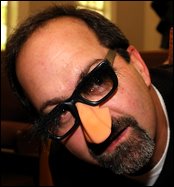
You may not know this, but Jimmy Jordan put me through this same exercise two weeks ago after he saw my widely acclaimed fully documented anonymous attack post “Bag o’ Snakes” and while I did not post my attorney’s counsel at that time, he concluded that James Jordan violated the Ninth Commandment when he accused me of violating copyright law. So rather than wait until Monday for me to contact my lawyer again, can you please point me to the exact US Copyright code that I violated and demonstrate how my use of the photograph (which you have not established belongs to you) does not conform to the Fair Use clause thereof? (I suggest you remove your Bozo mask before you read the code; methinks the funny glasses may have impaired your vision, if not your judgment.)

And when you discover that you, like Jimmy, are blowing smoke, I urge you to reflect on the words that you penned three days ago, which I cite pursuant to the Fair Use clause of US Copyright code:

People who take themselves too seriously should not be trusted. Besides, they’re not very fun to be around.

Far from being evidence of hubris, mocking one’s self and whatever “movement” one might be associated with is quite healthy. (“Humility & Humor”)

You see, Pastor Braveheart, your comment about “MY PROPERTY” leaves me with the distinct impression that you take yourself too seriously and that I should not trust you. Even worse, it persuades me that you’re not very fun to be around. So I encourage you to join me in mocking James Jordan, the Godfather of the Federal Vision “movement” you’re associated with, because it (mocking) really is quite healthy.

Thank you.

Worse Than None

The official Federal Vision Damage Control Unit swung into action this morning, trying to rehabilitate James Jordan’s complete meltdown on the worldwide web. Accordingly, the Federal Visionists successfully compelled their Godfather to post a comment on two blogs to seek forgiveness for “several overheated posts” and for “having troubled your waters.” Here is his comment in full:

Gentlemen,

I hereby ask your forgiveness for my several overheated posts over the last few days. I have deleted all but the first, which is the only thing I had any right to post to you; to wit: that there is nothing wrong with anyone’s commenting on the public actions and behavior of certain parties in the PCA, behavior that is public and that some regard as shocking and scandalous.

I was out of line in my comments here, partly because the rhetoric I employed is not appropriate in a public blog, and partly because, being neither in the PCA nor a presbyterian, anything beyond a general expression of concern or horror at how these affairs are being conducted is inappropriate.

I allowed my friendship with persons I believe are being wrongfully persecuted to inflame my language, and I wrote in anger, and I should not have done so.

So, please forgive me for having troubled your waters, and be assured that it will not happen again.

Sincerely,

James B. Jordan

As confessions go, this is about as offensive as Jordan’s original sin, which he happily affirms. So let’s take it point for point:

I hereby ask your forgiveness for my several overheated posts over the last few days.

Jordan seeks forgiveness for the sin of “several overheated posts,” though he leaves the word “overheated” undefined. What does he mean by “overheated”? Does he refer to a grown man throwing a sinful temper tantrum, or does he think he got a little too hot under the collar, so to speak? I once had an “overheated” engine, but I didn’t attribute sin to it, and my wife has “overheated” my coffee on occasion, but neither she nor the coffee committed sin. So we’ll have to see what Jordan means.

I have deleted all but the first, which is the only thing I had any right to post to you; to wit: that there is nothing wrong with anyone’s commenting on the public actions and behavior of certain parties in the PCA, behavior that is public and that some regard as shocking and scandalous.

Okay, he deleted all his comments from “John Armstrong’s Meddling Again” except the original comment, which is another way of saying exactly how much forgiveness he seeks because the original comment is no less offensive than all the reviling that followed it. In fact, it laid the foundation for everything else he wrote. Of course, this explains why he still believes the actions of the PCA are “shocking and scandalous.”

I was out of line . . .

This strikes me as an understatement. In 1 Corinthians 5:11 Paul does not instruct the Church to excommunicate “railers” because he believes reviling is merely “out of line.”

I was out of line in my comments here, partly because the rhetoric I employed is not appropriate in a public blog. . .

Jordan believes that his language was “not appropriate in a public blog” and he clearly implies that his language is absolutely appropriate for non-public-blog discourse, such as we see on the Biblical Horizons yahoo Group. In other words, this stipulation — this one single condition — protects the soul of Jordan’s conviction, which makes room for the abundance of his heart. His entire so-called confession hangs on this one line.

. . . and partly because, being neither in the PCA nor a presbyterian. . .

Off point, but this is a clear admission that the CREC, where he holds his membership, is not presbyterian, and to my knowledge he is the first confederate to make this admission.

. . . and partly because, being neither in the PCA nor a presbyterian, anything beyond a general expression of concern or horror at how these affairs are being conducted is inappropriate.

This admission is similar to Prince Blog’s admission that while he knows nothing about the PCA’s BCO, he still reserves the right to comment on the PCA’s proceedings. Of course, neither Beelzeblog nor James Jordan acknowledge that their Federal Visionist peers in the PCA affirmed the PCA’s form of government by covenant and all the boohooing in the world after the fact doesn’t remove their covenantal obligations. More importantly, however, when men admit their ignorance relative to a certain subject, it behooves them to refrain from editorializing on that subject. If a man does not understand presbyterian polity, then why would he pass judgment on the very polity he freely admits he doesn’t understand? In other words, Jordan shouldn’t even offer “general expression of concern or horror at how these affairs are being conducted” when he does not know how these affairs are being conducted. One follows the other in logical sequence. But the working assumption with all the Federal Visionists is that THEY are the authorities on all things ecclesia.

I allowed my friendship with persons I believe are being wrongfully persecuted to inflame my language. . .

And if he was any kind of friend to Wilkins, he would urge him to honor his vows. Further, if Jordan had any brains, he would take a moment to learn presbyterian polity. It might keep him from using words such as “wrongfully persecuted.”

. . . and I wrote in anger, and I should not have done so.

This apparently defines the word “overheated.” He “wrote in anger.”

So, please forgive me for having troubled your waters, and be assured that it will not happen again.

The whole “troubled waters” metaphor strikes me as one more poke in the eye. First, it casts Jordan in the role of the angel in John 5. Second, it plainly diminishes the magnitude of his sin. What’s the big deal? — he troubled the waters.

Charles Spurgeon, writing under the pseudonym John Ploughman, coined the proverb, “A good excuse is worse than none,” to convey the point that when confessing your sins, it’s always best to come all the way clean, and refusal to admit the whole truth only aggravates your sin. In this instance, Jordan’s confession furnishes us with a good example of peacemaking Federal Vision style: Hold to your sins; humble not yourself; and concede no points of fact. In other words, his confession is worse than none.

Thank you.

Tuesday, January 15, 2008

“Meet the Theonomists”

Earlier today I re-read “Meet the Theonomists” for the first time in many a moon and was blown away at Dr. Roche’s keen analysis and incredible foresight. Eight years ago he identified the key players in the Federal Vision — Wilson, Jordan, Leithart, Wilkins, Meyers, Schlissel, Smith, Bledsoe (I deleted his emails from “Bag o’ Snakes”) — before they ever had their Vision. He also identified their “high-church ecclesiocentrism,” their aberrant covenant soteriology, their depreciation of the new birth for “covenant children,” and in Wilson’s and Wilkins’ case, their absurd revision of Southern history (he even smelled plagiarism). Moreover, he saw from afar the rivalry between Wilson and Sandlin (if you don’t know how that one ended, read this), and back then he affirmed James Jordan’s “bizarre” hermeneutic.

Of course, since there was no Federal Vision when Dr. Roche wrote this essay (he wrote it two years before the 2002 AAPC), he categorized his analysis under “theonomy.” Nevertheless, it’s interesting to see how the theonomists have recast their message since then and how events have unfolded. Take the time to read “Meet the Theonomists” by Dr. Thomas Roche. He saw the Federal Vision in its germ state long before the Auburn Avenue clowns saw its infectious value and hatched it into their disease.

Thank you.

Monday, January 14, 2008

“Spaceship Moscow”

The latest Auburn Avenue high jinks furnishes me with an opportunity to plug this email written by Dr. Tom Roche, which I lifted from the BB Warfield list (fully documented anonymous attack bloggers don’t ask for permission to lift emails from public lists):

Re: [bbwarfield] From the Auburn Avenue Lampoon

It doesn’t sound like anything very new — in Credenda Agenda, for instance, Doug Wilson and his associates have long been explicitly noted for using hard, biting satire to respond to critics, often without even any attempt to answer the substantive arguments of said critics, and Wilson has written at least one essay specifically defending and bragging about this policy. Obviously, when you do not have a serious argument to rebut your critics, yelling and screaming at them and making fun of them will do, right?

Dr. Tom Roche
Norton, MA
Member — Lakeville Christian Fellowship

I call this to your attention because one Dr. Thomas Roche wrote an excellent essay called “Meet the Theonomists,” which was his farewell to theonomy and all its fruit loops. I do not know if the same man wrote both pieces, but I highly commend “Meet the Theonomists” because Dr. Roche nailed it eight years ago, predicting with incredible foresight Dougzilla’s mammoth influence on the Reformed world:

It may seem pretentious in the extreme for a self-taught former guitar leader, barely 40 years old, and Reformed for a period better measured in months than years, to start to try to export the Reformed faith, and build a national ministry presence in the Reformed orbit, but that is what Wilson did. . . . Clearly, it is obvious to me that Wilson and his associates not only see themselves as theonomists, but that they are eager to be the new primum mobile of this movement, complete with their visions for courtship, schooling, and church, in the post-Rushdoony era fast approaching. They are not actively hostile to Sandlin and the current Chalcedon crowd, not by any means, but they are rivals. Indeed, in my opinion Wilson’s is a textbook case of how to embrace a worldview and come from out of nowhere to establish yourself as a leading contender for movement leadership and a force that people think of when they consider said movement. As I said above, Wilson and his associates in Idaho constitute a colossos, and they are not going to fall into the sea anytime soon.

If you don’t read the whole essay, which is well worth your time, then at least read the subsection “Spaceship Moscow” for its insight. By the way, the Sandlin reference just kills me.

Thank you.

Wednesday, January 2, 2008

Biblical Horizons

Here’s some more information about the Biblical Horizons yahoo group, taken straight from the website’s front page.

Group Information
Members: 222
Category: Adult
Founded: Jan 23, 2001
Language: English

Group Settings
  • Membership requires approval
  • Messages do not require approval
  • All members can post messages
  • Email attachments are permitted
  • Members cannot hide email address
  • Listed in directory
Description
I. BH PURPOSE STATEMENT
  1. Biblical Horizons’s list is a restricted email forum that exists to foster informal discussions on matters of biblical and theological issues from a Reformed theological perspective. Many of us on the list are good friends and we will often speculate freely without fear of overbearing chastisement from each other. BH exists for intramural discussions among those who share certain biblical and theological convictions. BH welcomes discussions of these and any well-considered Biblical themes, but if you disagree with our common assumptions, then as our guest we hope you will respond to our hospitality with your respect for our ideas. (You may be asked to find another forum if you cannot refrain from argumentative disputation.)

  2. You must be a subscriber to Biblical Horizon’s newsletter to join this list! We will cleanse the list of those whose subscription is not current. To subscribe send your name and address to

    Biblical Horizons
    P.O. Box 1096
    Niceville, Florida 32588

    or call 850-897-5299. You may also email James B. Jordan (jbjordan4@cox.net) with your request. We will extend a free six-month trial subscription to anyone who asks to be on the mailing list. After that, you should make an appropriate donation to continue to receive the mailings. Only those who have made financial donations are eligible to join the email list.
There are only two differences between Biblical Horizons and a similar yahoo discussion group, the BB Warfield list, which I frequent but am not a member:
  1. Biblical Horizons requires approval for membership but does not require approval for messages, and
  2. BB Warfield does not require approval for membership but does require approval for messages.
And since Biblical Horizons requires approval for membership, their archives are closed to the general public, unlike BB Warfield.

This brings me to another point that I’ve raised in the past. If I was a prosecutor for the PCA in its upcoming trial of Louisiana Presbytery, I would immediately apply to join Biblical Horizons so that I could mine the archives for posts written by the accused, because those archives work exactly the same way as Warfield’s (though I suspect if they let a prosecutor in they would see an immediate purge). The point is that these clowns say one thing in public and another in private.

Thank you.

NB

“He who hates, disguises it with his lips,
And lays up deceit within himself;
When he speaks kindly, do not believe him,
For there are seven abominations in his heart;
Though his hatred is covered by deceit,
His wickedness will be revealed before the assembly.”
— Proverbs 26:24–26

I want everyone to notice this. All of the men who contributed to my post “Bag o’ Snakes” should be ashamed of themselves — every one of them. They should be ashamed that as so-called pastors of God’s sheep and leaders in their respective congregations they willingly participated in an orgy of gossip, backstabbing, and vituperation. They should be ashamed for plotting behind the backs of the brethren; they should be thoroughly embarrassed that they connived to poison the Church; they should hide their faces in humiliation for joining hands in such ungodliness. But as the prophet asked, and answered, “Were they ashamed when they had committed abomination? nay, they were not at all ashamed, neither could they blush” (Jer. 8:12).

And why can’t they blush? — because in their minds this malicious bender didn’t involve wrongdoing since it took place in their private “members only” club where they agreed to commit sin with impunity. The argument goes like this: Sin isn’t sin if everyone agrees to commit sin. Makes sense to me. This also explains why the FVists won’t stop. Men who cannot discern the difference between righteousness and iniquity have no point of reference for anyone to appeal to. St. Paul put it this way: “Now the Spirit expressly says that in latter times some will depart from the faith, giving heed to deceiving spirits and doctrines of demons, speaking lies in hypocrisy, having their own conscience seared with a hot iron” (1 Tim. 4:1, 2).

Also, please note Beelzeblog’s response to this. As the Fearless Leader of the new Reformation, he did not correct or admonish his fellow Reformers for their sin. He didn’t say, “Now, now, brothers, spiteful tongues cannot usher in the new Reformation, and we should not mix our new wine with the vinegar of contempt. Let us trust God that he will open the eyes of our Reformed brethren to our novel understanding of the Westminster divines’ original intent.” Rather, he seized the opportunity to unify the gang behind one message of solidarity while simultaneously maintaining an open bridge to RC Jr., which he eventually exploited to his own ends (padding the CREC) after the RPCGA lawfully removed the St. Peter’s Four from the ministry.

Notice also how the FVists have trained their disciples to respond. Look at this comment from a loyalist or, more likely, from an FVist:

Anonymous has left a new comment on your post “Bag o’ Snakes”:

You are in violation of USC tile 17 $106 and $106A. If I were the authors of these email’s, i would be talking to a lawyer now.

Good luck.

Well, Anon, at least you’re consistent: when in doubt, retaliate. For the sake of argument, however, let’s follow Anon’s counsel to its logical conclusion. If I understand him correctly, he believes that the leaders of the new Reformation should file a class action lawsuit against me for publishing their own words to expose their little cabal. This is beautiful. It’s also an efficient means of reformation. “Ecclesia reformata, semper suing.”

And as I’m writing, James Jordan just posted this comment:

I notice that you have published comments made by me in a private forum, without permission. This is a violation of federal copyright law, and I advise you to remove this material immediately, or face the consequences. — James B. Jordan

I can see it now:

Question: “Dr. Jordan, how did my client’s actions damage you?”

Answer: “Your client damaged me because I didn’t want the general public to know that I am a bitter, greedy, foul-mouthed, collar-wearing scoundrel.”

That should be worth a huge award, and all that time in court should pay dividends as well. The media would have a First Amendment field day and my hits would soar through the roof (or “New Sky”). Everyone — the whole world — would get a glimpse of the new Reformers’ hearts, which, if you think about it, is very postmillennial.

But fair enough. I’ll call my attorney. If I have violated the law (which I doubt) I shall remove Jordan’s copyrighted material from the post and apologize to him. Until then, however, I think it’s important for everyone to see the stinking rats behind the fridge.

Thank you.

Friday, December 21, 2007

No Tolerance

Last night I was looking for my copy of RJ Rushdoony’s The Institutes of Biblical Law, to see what he says the Bible demands for plagiarizers. I found volumes 2 & 3, but I couldn’t find the first volume. So I looked around the web and while I couldn’t find anything on plagiarism, I inadvertently fell on this little nugget that explains why the Federal Visionists will not bend one bit as they impose their doctrine on the Reformed church with extreme prejudice. In short, they have adopted a policy of no negotiation because they believe any concession amounts to “suicide”:

2. The Law as Revelation and Treaty
Law is in every culture religious in origin. Because law governs man and society, because it establishes and declares the meaning of justice and righteousness, law is inescapably religious, in that it establishes in practical fashion the ultimate concerns of a culture. Accordingly, a fundamental and necessary premise in any and every study of law must be, first, a recognition of this religious nature of law.

Second, it must be recognized that in any culture the source of law is the god of that society. If law has its source in man’s reason, then reason is the god of that society. If the source is an oligarchy, or in a court, senate, or ruler, then that source is god of that system. Thus, in Greek culture law was essentially a religiously humanistic concept. In contrast to every law derived from revelation, nomos for the Greeks originated in the mind (nous). So the genuine nomos is no mere obligatory law, but something in which an entity valid in itself is discovered and appropriated. . . . It is “the order which exists (from time immemorial), is valid and is put into operation.”[1]

Because for the Greeks mind was one being with the ultimate order of things, man’s mind was thus able to discover ultimate law (nomos) out of its own resources, by penetrating through the maze of accident and matter to the fundamental ideas of being. As a result, Greek culture became both humanistic, because man’s mind was one with ultimacy, and also neoplatonic, ascetic, and hostile to the world of matter, because mind, to be truly itself, had to separate itself from non-mind.

Modern humanism, the religion of the state, locates law in the state and thus makes the state, or the people as they find expression in the state, the god of the system. As Mao Tse-Tung has said, “Our God is none other than the masses of the Chinese people.”[2] In Western culture, law has steadily moved away from God to the people (or the state) as its source, although the historic power and vitality of the West has been in Biblical faith and law.

Third, in any society, any change of law is an explicit or implicit change of religion. Nothing more clearly reveals, in fact, the religious change in a society than a legal revolution. When the legal foundations shift from Biblical law to humanism, it means that the society now draws its vitality and power from humanism, not from Christian theism.

Fourth, no disestablishment of religion as such is possible in any society. A church can be disestablished, and a particular religion can be supplanted by another, but the change is simply to another religion. Since the foundations of law are inescapably religious, no society exists without a religious foundation or without a law-system which codifies the morality of its religion.

Fifth, there can be no tolerance in a law-system for another religion. Toleration is a device used to introduce a new law-system as a prelude to a new intolerance. Legal positivism, a humanistic faith, has been savage in its hostility to the Biblical law-system and has claimed to be an “open” system. But Cohen, by no means a Christian, has aptly described the logical positivists as “nihilists” and their faith as “nihilistic absolutism.”[3] Every law-system must maintain its existence by hostility to every other law-system and to alien religious foundations, or else it commits suicide. (Rousas John Rushdoony, The Institutes of Biblical Law, “Introduction” [Phillipsburg, New Jersey: P & R Publishing, 1973] 5, 6)

[1] Hermann Kleinknecht and W. Gutbrod, Law (London: Adam and Charles Black, 1962), p. 21.


[2] Mao Tse-Tung, The Foolish Old Man Who Removed Mountains (Peking: Foreign Languages Press, 1966), p. 3.


[3] Morris Raphael Cohen, Reason and Law (New York: Collier Books, 1961), p. 84 f.

Thursday, December 20, 2007

Theonomic Plagiarist

From P&R News, Volume 6 Number 2, March—April 2000, page 7:

Steve Wilkins: “Is theonomy Reformed? Of course it is, or why would I embrace it? That’s the pro hominen argument.” * * * * Speaking of contemporary civil magistrates: “They are very good at regulating the price of milk, and what should go on a pizza, but they can’t catch a thief and they don’t know what to do with him if they do.”

Two questions:
  1. If theonomy is Reformed and “Reformed” is not enough, then is “theonomy” enough? Okay, bad question. Let’s try another:

  2. If the civil magistrate can’t catch a thief and wouldn’t know what to do with him if they did catch him, then what should a theonomic presbytery do with a plagiarist in their ranks?
Of course, I ask my second question with the assumption that plagiarism is theft.

Thank you.

Monday, October 15, 2007

Southern Schism As It Is

I have taken the following article from Presbyterian & Reformed News (volume 4, issue 1). You should read it in conjunction with this article by the Southern Poverty Law Center.

PCA Founding Congregation and Its Pastor Leave for EPC
Toleration of Theonomy and Views of Political Secession Given as Reasons for Departure

Grace Presbyterian Church of Alexandria, LA, voted on December 7, 1997, to leave the denomination it helped to found, in order to become a part of the Evangelical Presbyterian Church (EPC). The reasons for the departure, according to the Pastor, revolved around the toleration of theonomy in the Presbyterian Church in America (PCA). Also cited in Rev. Robert Vincent’s statement was that at least some theonomists are advocates of political secession from the Federal Union.

At a December 29, 1997, called meeting of Louisiana Presbytery (PCA), Mr. Vincent, who was the Moderator of the court, immediately yielded the chair to the Moderator-elect for the entire meeting. During the discussion of his dismissal to the EPC, Mr. Vincent read the following statement orally and into the record:

Dear Fathers and Brothers:

As I come to make this petition to be dismissed from you into the Presbytery of the Central South of the Evangelical Presbyterian Church, I do so with grief. Having served the Presbyterian Church in America for the past twenty-two years, I continue to hold it in high esteem and deep affection.

I first encountered Theonomy from a fellow student, the late Greg Bahnsen. By the time that I finished seminary I had substantially formed the views that I hold today and concluded that what he and Drs. Rushdoony and North espoused was contrary to Scripture. However, being committed to a measure of diversity within the banks of Reformed orthodoxy, I was an advocate of toleration for Theonomists. Not only did I examine and approve each of you, my Theonomic brothers, but I once served on an Assembly judicial commission and voted to censure one of the founders of the Presbyterian Church in America for his circularizing his presbytery against a young Theonomist. That tolerance has been repeatedly affirmed by the General Assembly (cf. M7GA, 1979, pages 194–195; M10GA, 1982, page 107; M11GA, 1983, page 96.), but I now find myself out of accord with the Assembly’s position.

What is the issue?

All of us, Theonomists and Non-Theonomists alike, affirm that we are saved by grace alone, received through faith alone. We all agree that saving faith is never alone but is always accompanied by a changed life, increasingly godly but imperfect until we go to be with the Lord Jesus. We all agree that the entire Bible is the inerrant Word of God, the only infallible rule of faith and life. We all agree that God’s Moral Law, summed up in the Ten Commandments, is part of the abiding standard for determining what constitutes godly living. None of us is an Antinomian; none of us teaches justification except by faith alone. That is true for the teaching elders of Louisiana Presbytery, and it is true for the ruling elders of my congregation as well.

Where we differ has to do with the issue of the continuing validity of the civil laws of Israel and whether or not the state is obligated to enforce those Old Testament judicial laws and their penalties. My view is that Israel as a nation with its political and legal structure served a unique function in the purpose of God. That purpose has been fulfilled in Christ. Under the overarching unity of the covenant of grace, there is diversity in its administration. Where Dispensationalism errs in its failure significantly to grasp the overarching unity, I believe that Theonomy errs in its failure significantly to grasp the diversity between the two Testaments.

That failure leads to a concern with politics and materialistic dominion. In my opinion, that error has led some Theonomists into involvement with organizations such as the League of the South. That organization states: “We see no way of reforming the corruption within the present system; therefore, The League of the South shall seek to spread acceptance of the idea of secession among the people of the South.” (“The League of the South Position On Secession” under “LS Position Papers” at http://www.dixienet.org)

To be active and supportive of presbytery, one must agree with its mission. A presbytery with a Theonomic vision is frightening to me. When Christian men believe that their position is biblical, they will inevitably seek to make it the dominant and controlling view. Inasmuch as I perceive this to be the direction of Louisiana Presbytery, and inasmuch as the issue of Theonomy has been adjudicated by the General Assembly contrary to what I now believe is wise, I can no longer participate in good conscience without rupturing the peace of Presbytery and therefore believe that it is in the best interest of the church that I seek affiliation in another communion.

As I go, I commend you to God. May the Holy Spirit guide you in your understanding of biblical truth.

Respectfully submitted,

Robert Benn Vincent, Sr.

Bob Vincent, a native South Carolinian, graduated from Presbyterian College in Clinton. He attended Westminster Theological Seminary for two years before transferring to Reformed Presbyterian Theological Seminary in Pittsburgh. He was ordained in the Reformed Presbyterian Church of North America (RPCNA), serving for two years at the Covenanter congregation in Wichita, KS. (The RPCNA still maintains the Presbyterian practice of a capella exclusive psalmody. It also has an historic egalitarian emphasis, as seen in its advocacy of abolitionism and its ordination of women to the diaconate.)

When called to the Alexandria church in 1975, Vincent held to traditional Presbyterian worship. Over the years, his views evolved, as did those of the congregation.

Not everyone in the church was happy with those changes, including “contemporary worship” practices and what was regarded as a charismatic flavor to the service. A decade ago, a number of people left Grace Presbyterian Church in order to found an Orthodox Presbyterian Church in neighboring Pineville.

Since the mid-1980s, the leadership at Grace Presbyterian has practiced anointing with oil in conjunction with prayers for healing and for fruitfulness in child-bearing. Two years ago, one of the officers anointed with oil a computer that had crashed: after the anointing and prayer, the information on the hard-drive which had not been “backed-up” was able to be retrieved.

Originally known as Jackson Street Presbyterian Church, the Alexandria congregation was pastored from 1969 to 1975 by A. Michael Schneider, a conservative who identifies himself as a theonomist. In 1973, the church was a member of Mississippi Valley Presbytery, and later helped to organize Louisiana Presbytery. At least one of its ruling elders had served at the General Assembly level: Dick Ayres, who was on the Committee on Administration from 1977 to 1981.

At the end of 1973, the church listed a total membership of 156. At the end of last year, its membership (communicant and non-communicant) totaled 294. Although the loss of almost 300 members is significant for a presbytery the size of Louisiana, there may not be any loss felt financially. According to the denominational Yearbook, in 1996 the church contributed nothing to the Presbytery, which had a total income of $36,505. (In 1994 and 1995, the church contributed $565 each year.)

On December 29th, Louisiana Presbytery voted to dismiss the church and its pastor to the Evangelical Presbyterian Church. The EPC, formed in 1981, is widely perceived as “looser” in its theological practice than the PCA, as in being more tolerant than the PCA on such matters as the charismatic movement. Although apparently not an issue in this transfer, the EPC and the PCA differ with regard to female ordination: the EPC allows for the ordination of women to all ecclesiastical offices (minister, elder, deacon), while the PCA allows for male-only ordination.

The Rev. Dennis Flach, Stated Clerk of the Central South Presbytery of the EPC, confirmed that that court voted at its meeting in Katy, TX, January 23–24, 1998, to receive Grace Presbyterian Church and its pastor; as well as to receive a group in Opelousas, LA, which had withdrawn from the local PCA church. According to an informed source, three elders had left Westminster Presbyterian in the early 1990s. Those same men and their families came back to that church for a time; one of them eventually left for a Baptist Church in Lafayette, while the other two became involved in Atchafalaya Presbyterian Church, a small PCA congregation in Melville, LA. At the October 18, 1997, meeting of Louisiana Presbytery, Grace Presbyterian announced its intention to establish a mother-daughter relationship between itself and the group in Opelousas, with Bob Vincent to preach at public worship there starting the next day. In response, Louisiana Presbytery established a committee to study the matter and report back at the next stated meeting-an issue that is now moot. Meanwhile, the EPC Central South Presbytery, at its January meeting, gave oversight of this “mission project” to the New Church Development Committee, which serves as a temporary governing body.

In an e-mail communication in late January, Mr. Vincent expressed his regret over any questioning of motives he may have made in his actions with regard to the separation from Louisiana Presbytery. He wrote: Our presbytery has enjoyed a very peaceful existence throughout its twenty-three years of existence. Recently, that peace was disturbed. I had a major part in that, and it was over my perception of trends in our presbytery related to Theonomy.

Other presbyters’ perception differs from mine. No charges were filed by me or by anyone else, partly because the General Assembly has taken positions on the issue, and partly because there was significant disagreement as to what various men actually believed. Apart from solid corroboration, it would be wrong for me to impute views to others that they deny holding. I am reminded of Saint Paul’s words: “My conscience is clear, but that does not make me innocent. It is the Lord who judges me. Therefore judge nothing before the appointed time; wait till the Lord comes. He will bring to light what is hidden in darkness and will expose the motives of men’s hearts. At that time each will receive his praise from God.” (1 Corinthians 4:3–5)

I do not want to stir up more strife. I explained our actions to Louisiana Presbytery, and I have tried to do the same to some folk in the Evangelical Presbyterian Church. Knowing that I am a sinner and that apart from grace I cannot even know my own heart, I shudder at the thought of publicly judging other men’s motives.

The people of Louisiana Presbytery love the Lord Jesus and are committed to the Reformed faith. I do not want to violate Romans 14:4, “Who are you to judge someone else’s servant? To his own master he stands or falls. And he will stand, for the Lord is able to make him stand.”

The Stated Clerk of Central South Presbytery (EPC) also recently reflected on these transfers to his denomination. According to Mr. Flach, the decision by Mr. Vincent to leave the PCA and join the EPC was not a hasty one, as he wrestled for about six months with the question of denominational affiliation and what he should share with his congregation. Mr. Flach believes that the EPC is a legitimate option for a PCA minister to consider, in that he could feel free to maintain theological positions on a variety of subjects (such as the ordination of women and the charismatic gifts) that might be “stricter” than those required by the denomination as a whole. In the Clerk’s view, the move by Pastor Vincent and Grace Church to the EPC could be characterized as a realignment for the sake of peace.